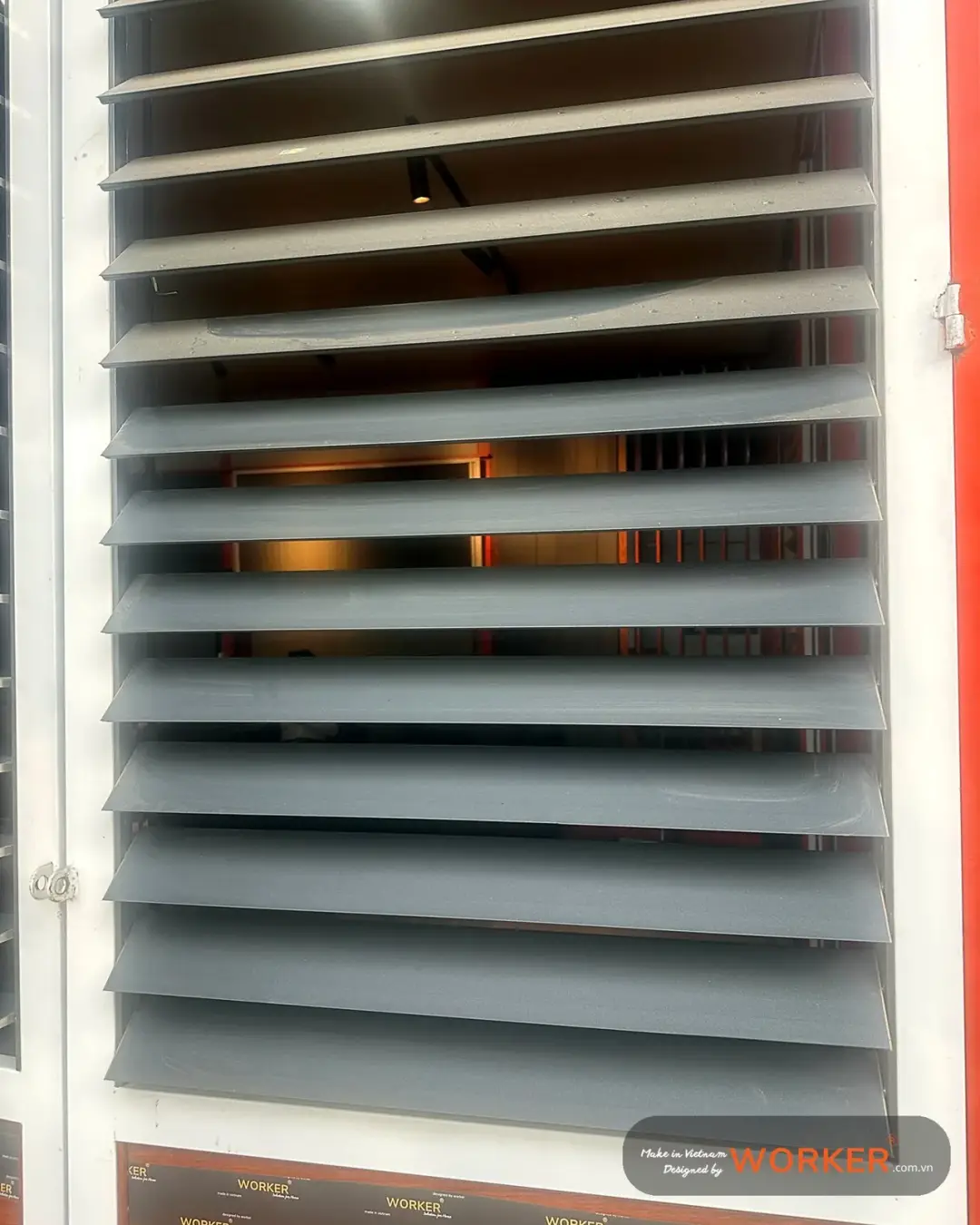
An operable louvre is an opening made of a surround frame and a row of blades that pivot on their ends. The blades are linked together, so one operation turns the whole row to the same angle. WORKER's three operable systems (Max, Pro, Smart) adjust from 0° to 90°: open the blades for air and daylight, close them to block sun, reduce driving rain and keep privacy. Unlike fixed louvres, operable louvres let occupants change the setting as the weather changes during the day.
This article is written for architects, contractors and developers who need to specify operable louvres: the components, the types of operating mechanism, the specifications of the three operable systems, how to choose a system by span, how to divide openings, blade orientation, combining louvres with glazing, and finally how prices are calculated and what to send for a quotation.
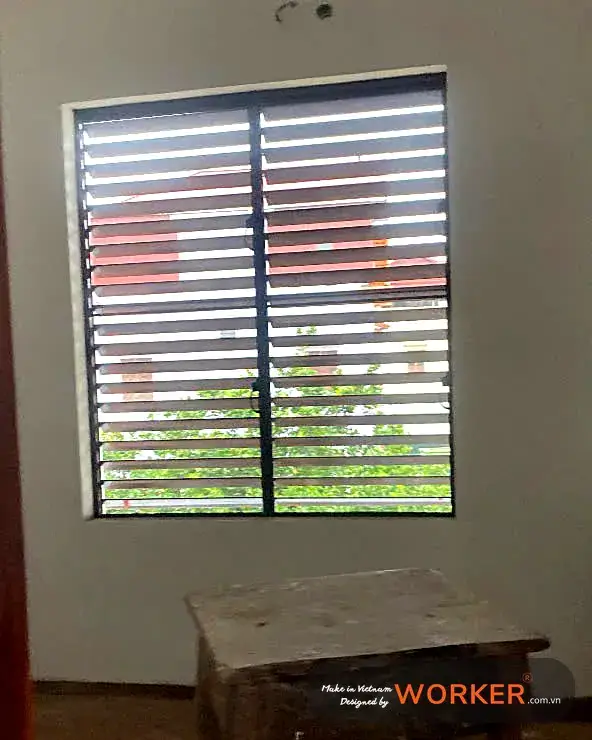
Worker-Pro operable louvre window with the blades open for ventilation, seen from inside. See the project page.
What is an operable louvre?
An operable louvre (also called an adjustable louvre or louvred shutter) is a louvre in which every blade rotates on pivots at both ends. The blades are joined by a linkage, so they always turn to the same angle. The angle is changed by a lever, an operating bar or a motor.
Three settings are used most often:
- Open: the blades turn to the widest angle, the gaps between them are at their largest and the most air and light come through.
- Part-open: the blades sit at a moderate angle, so air still passes while direct sun and views from outside are cut.
- Closed: the blades overlap and the opening is almost shut. On WORKER's three operable systems the blades close 95–98% tight, block 95–98% of driving rain and give 80% heat insulation, so air-conditioned rooms can still use louvres.
A fixed louvre is the opposite: the blades are fixed to the frame at a set angle, with no pivots and no linkage, and there is only one setting all year round.
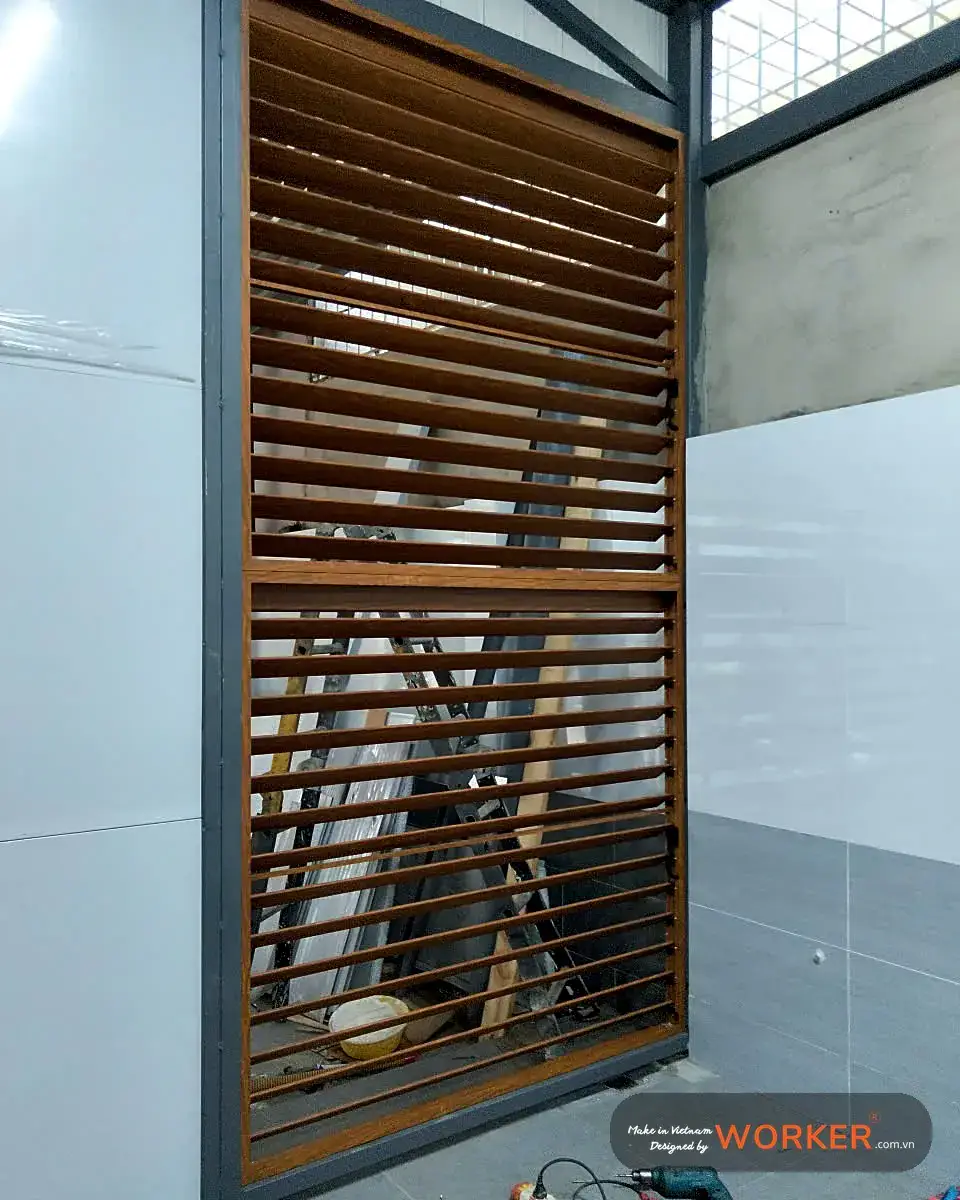
The same opening with both tiers open: air and light pass through the whole opening.
Components of an aluminium operable louvre
An operable louvre consists of the body (frame and blades) and the parts that move the blades (pivots, end caps, linkage, lever or motor). Each should be stated in the specification, because these are what keep the blades turning smoothly and closing evenly over the years.
| Component | Function | What to state in the specification |
|---|---|---|
| Surround frame | Holds both pivot ends of every blade; fixed to the wall or an existing frame | Frame section and wall thickness (mm), aluminium alloy, finish colour |
| Blades | Shade the sun, shed rain, let air through; close to shut the opening | Blade size (width × depth × wall thickness), blade profile |
| Pivots | Let each blade rotate at both ends | Pivot material (stainless steel or other), diameter |
| End caps | Close both blade ends, where the blade bears on the pivot | End cap material and thickness |
| Linkage | Joins the blades so they turn together to the same angle | Exposed linkage or concealed mechanism |
| Lever / operating bar | The point where the user changes the angle | Position and reach for the user |
| Motor (optional) | Turns the blades electrically for high, hard-to-reach openings | Which openings are motorised, power supply at the position |
The frames and blades of WORKER's three operable systems are made from 6063-T5 aluminium. Pivot and end cap materials for each system are listed in the specification table below.
Operating mechanism: exposed linkage and concealed mechanism
The linkage is what makes the whole row of blades turn at once. Two types are common:
- Exposed linkage: a bar runs along the blades, usually on the inside face, connected to each blade. It is visible and easy to inspect, but the bar shows on the face of the louvre.
- Concealed mechanism: the blade-adjusting mechanism sits inside the frame and does not show. The face of the louvre is flat, neat and easy to clean. This is how Worker-Smart works (60° rhombus blades, PC plastic fittings).
Operation:
- Lever / operating bar: suits openings within reach, such as room windows, balconies and loggias.
- Motor: for high openings, lightwells and large screens that are hard to reach. A WORKER louvre motor costs 2,500,000 VND per set. Which openings can take a motor is confirmed by WORKER's technical staff for each opening size; decide this at the design stage so that a power supply is provided.
For ground-floor openings, openings on the street or houses that are often empty, a reinforced 6 mm stainless steel anti-theft pivot core can be added at 250,000 VND per m² of louvre.
The 0–90° blade angle and closure when the blades are shut
The blade angle determines how much the louvre can regulate. WORKER's three operable systems turn from 0° to 90°, so one opening can go from fully closed to fully open. In daily use, occupants often keep the blades part-open at midday: air still flows, but the sun does not fall straight onto the floor.
Closure when shut (95–98%) is worth stating in the specification because it relates directly to two common client requirements: blocking driving rain (95–98%) and keeping air conditioning effective (80% heat insulation). The more evenly the blades close from one end to the other, the smaller the gaps, so blade stiffness along its length matters as much as the closure figure.
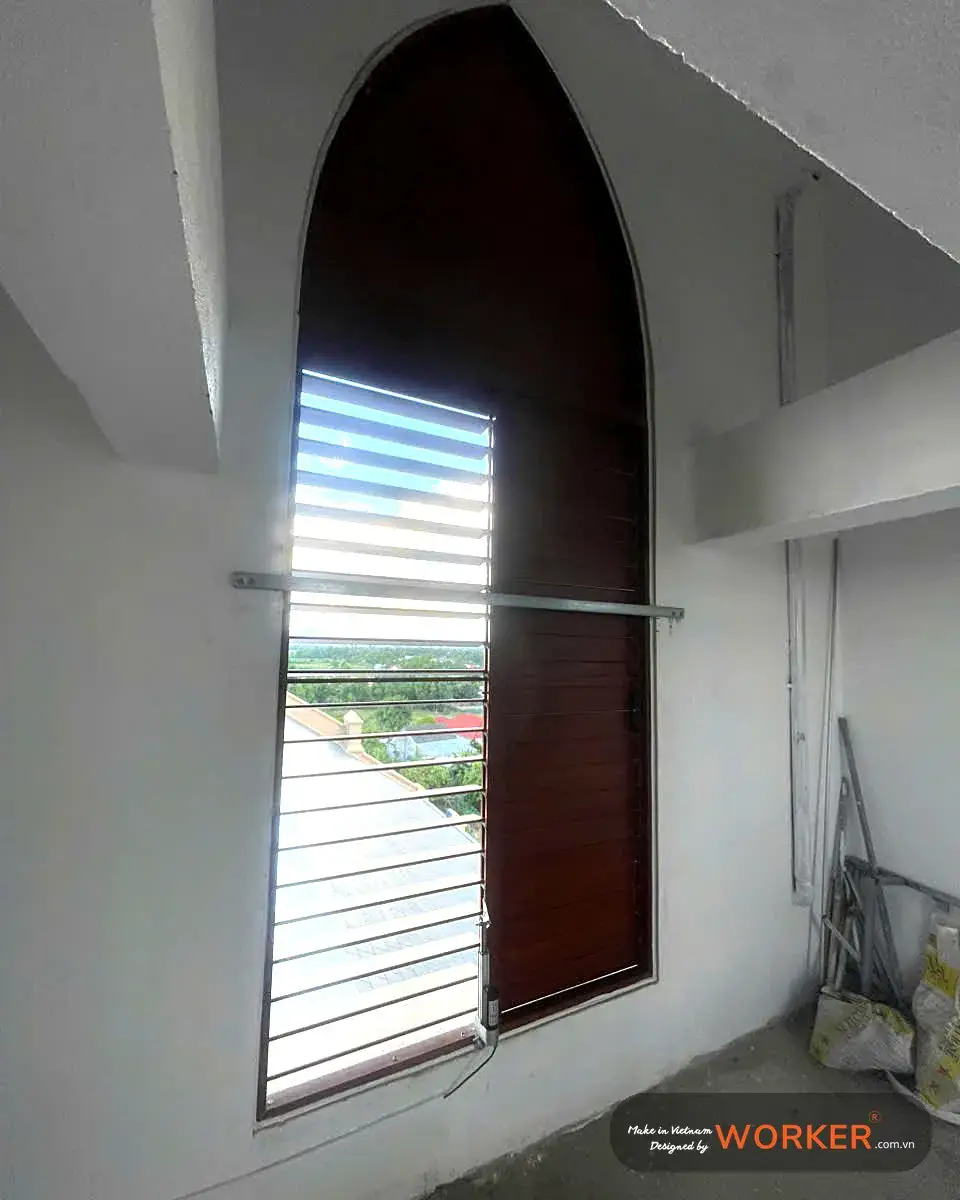
Red woodgrain louvres on a pointed-arch window.
How do operable louvres differ from fixed louvres?
| Criterion | Operable (Max, Pro, Smart) | Fixed (Worker-Fixed) |
|---|---|---|
| Blade angle | Adjustable 0–90° | Fixed at one angle |
| Settings during the day | Open, part-open, closed to suit the weather | One setting all year |
| Moving parts | Pivots, linkage, lever or motor | None |
| Construction | Single blades in a frame, blades rotate | Double frame + double blades, blades fixed |
| Product warranty | Max, Pro 5 years; Smart 3 years | 20 years |
| Unit price (from 1 m²) | 1,890,000–2,590,000 VND/m² | 1,990,000 VND/m² |
| Suits | Living rooms, balconies, loggias, places that need different settings | Vents, plant areas, façade screens, hard-to-reach places |
Quick rule: where people live every day and need to adjust air and sun by the hour, use operable blades; where only year-round ventilation is needed and the opening is rarely reached, use fixed blades. See the Worker-Fixed specification for a fixed-blade option.
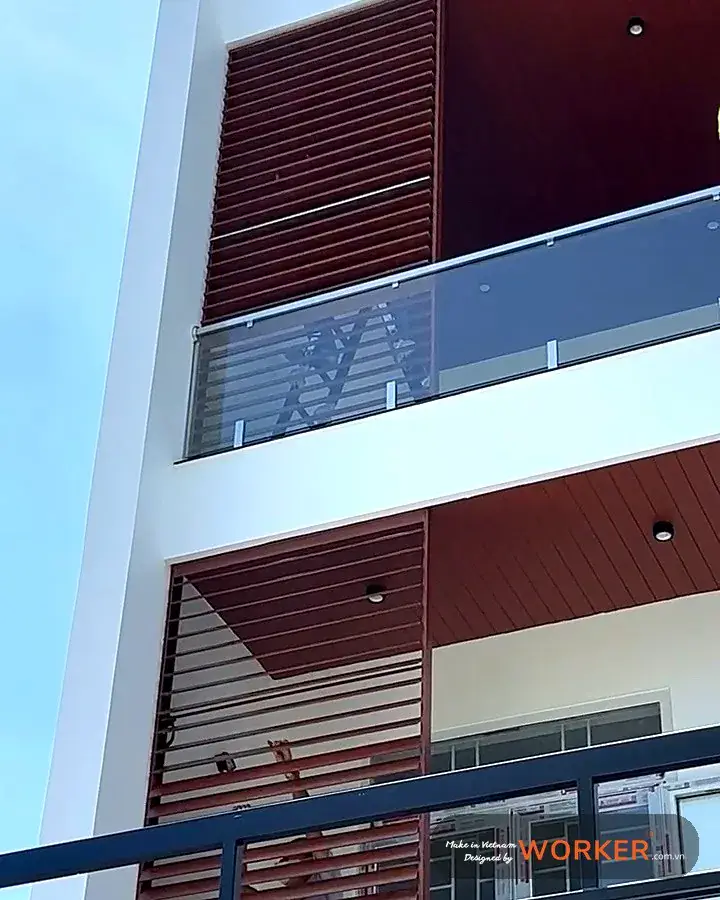
Red woodgrain balcony louvres seen from below.
Specifications of WORKER's three operable aluminium louvre systems
| Specification | Worker-Max | Worker-Pro | Worker-Smart |
|---|---|---|---|
| Blade (mm) | 140 × 20 × 1.1 | 100 × 10 × 1 | 85 × 15 × 1 |
| Frame (mm) | 25 × 50 × 1.2 | 70 × 30 × 1.1 | 30 × 19 × 1 |
| Blade profile | 60° rhombus, 2 internal webs | Stylised teardrop | 60° rhombus, concealed mechanism |
| Fittings | 6 mm stainless steel pivots, 3 mm aluminium end caps | 6 mm stainless steel pivots, 2 mm 304 stainless steel end caps | PC plastic fittings |
| Blade angle | 0–90° | 0–90° | 0–90° |
| Best suited to | Large spans, façades, seamless up to 3.5 m | Openings under 1.7 m, locations exposed to driving rain | Fitting onto aluminium-glass systems, refurbishment |
| Unit price | 2,590,000 VND/m² | 2,390,000 VND/m² | 1,890,000 VND/m² |
| Product / paint warranty | 5 years / 15 years | 5 years / 15 years | 3 years / 5–15 years |
Colours: Giáng Hương wood grain, Cẩm Lai wood grain, Olerk Nordic wood grain and metallic stone grey. Colours vary by system; WORKER's staff send the colour chart when the specification is prepared.
Specifying operable louvres in the design documents
Choosing the system by span and location
Each blade acts like a small beam supported on the two sides of the frame, so the span (the length the blade must bridge) is the first figure to check. The longer the blade, the more easily it sags at mid-span, closes unevenly and turns less smoothly.
- Façade screens and wide openings that need to be seamless: Worker-Max, 140 mm blades with 2 internal webs, seamless up to 3.5 m.
- Windows, balconies and verandas under 1.7 m and places exposed to driving rain: Worker-Pro, teardrop blades that shed water quickly and 304 stainless steel end caps that hold up in humid conditions.
- Openings that already have an aluminium-glass frame, refurbishment or tighter budgets: Worker-Smart, a 30 × 19 × 1 mm frame that fits onto existing aluminium-glass systems.
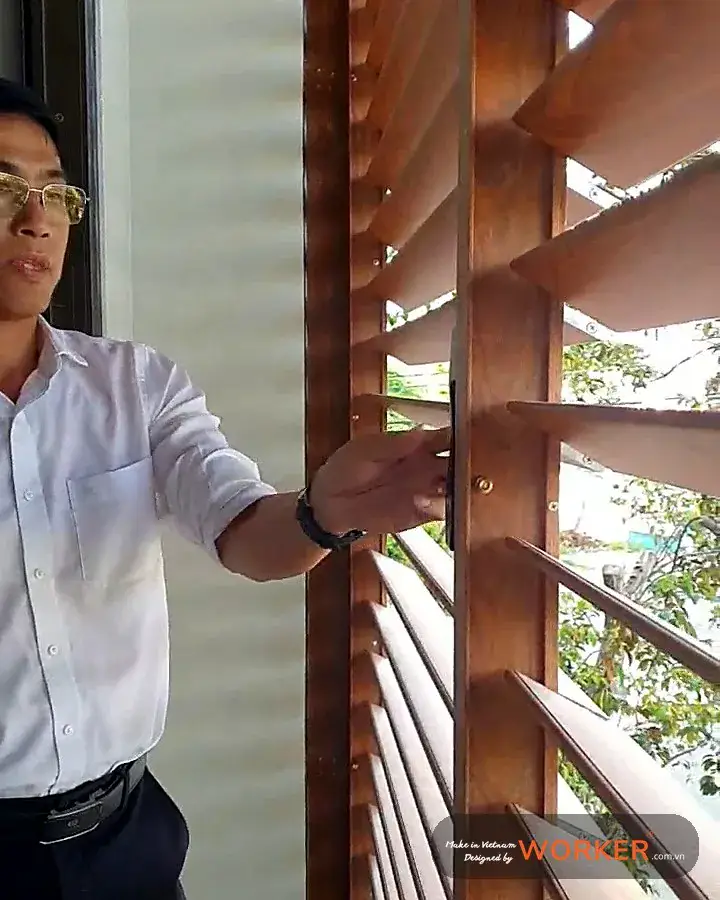
Customer trying the woodgrain balcony louvres.
Dividing openings and blade tiers
If an opening exceeds the span of the chosen system, divide it with vertical mullions into smaller openings; for tall openings, divide the blades into tiers. Tiers have two benefits: shorter blade runs make operation lighter, and occupants can open one tier and close another as needed (as in the two-tier photos above). A common arrangement is to close the lower tier for privacy and open the upper tier for air.
When dividing, keep mullions in line with those of the adjacent glazing or door frames so the elevation looks orderly.
Horizontal or vertical blades
Horizontal blades are the usual choice: rain runs off the blade face to the outside, and closed blades shade high-angle sun. Vertical blades are often chosen for balcony screens, partitions or where low-angle side sun and oblique views need to be blocked. WORKER makes both; state the blade direction on the elevation.
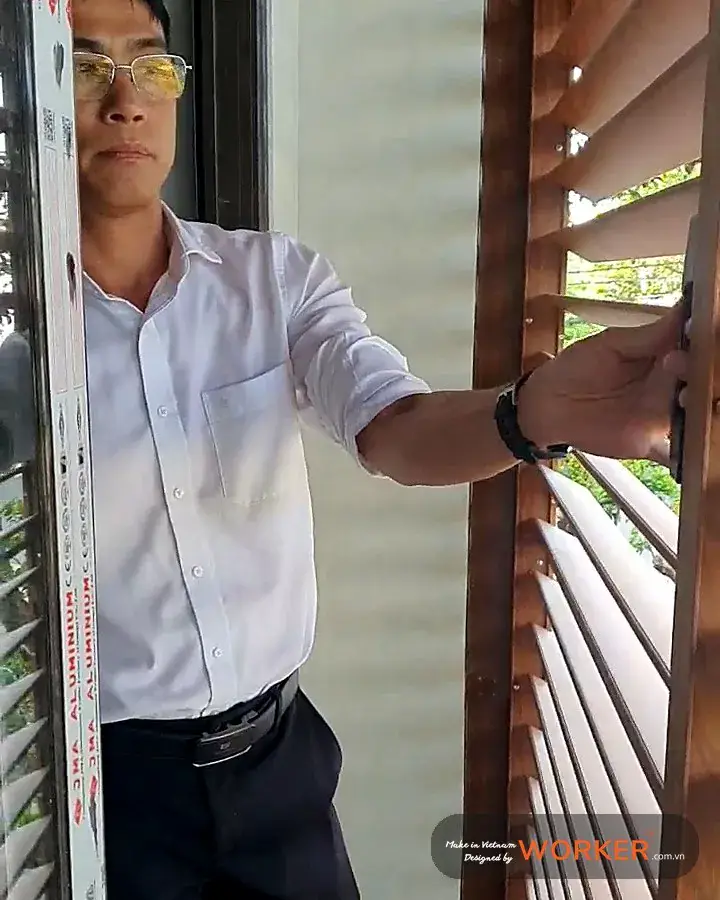
Customer trying the woodgrain balcony louvres.
Blade direction and drainage
With horizontal blades, closed blades must shed water to the outside of the building, not onto the inner sill. On elevations that take rain head-on, choose Worker-Pro (teardrop blades) and check the sill fall and the sealant around the frame. Locations that need ventilation but must keep rain out are covered on the ventilation and driving-rain louvres page.
Combining louvres with glazing
Two common ways when an opening needs both glass and louvres:
- Glass inside, louvres outside: the operable louvre sits outside and the glazed window inside. The glass can be shut in heavy rain, and the louvre shades the sun before it reaches the glass.
- Louvre panel on an existing glazed door or window: use Worker-Smart fitted onto the aluminium-glass system, which suits refurbishment projects.
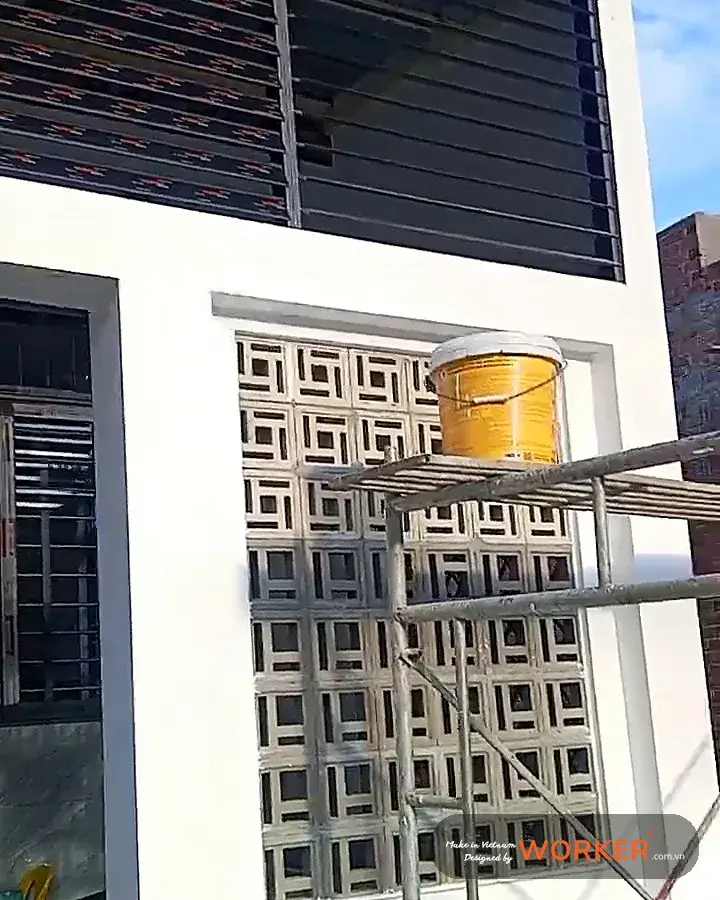
Townhouse with balcony louvres and glass doors.
Lever position and reach
Openings within reach (windows, balconies) only need a lever. For openings above head height, lightwells and upper stairwell openings, plan for motors from the start; otherwise the operable louvre will stay in one position like a fixed louvre, at a higher price.
Where to use operable louvres, and where not
Use operable blades for:
- Bedroom, living room and study windows: blades open in the morning, part-open at midday, closed at night.
- West-facing balconies and loggias that get afternoon sun: close the blades against low-angle sun.
- Elevations that take rain head-on and need to be shut in storms.
- Façade screens where openness and privacy should change with the season.
Fixed blades are enough for:
- Bathroom vents, storerooms, plant rooms, air-conditioner condenser areas.
- Decorative façade screens, fences, roof gables.
- Very high openings without a motor.
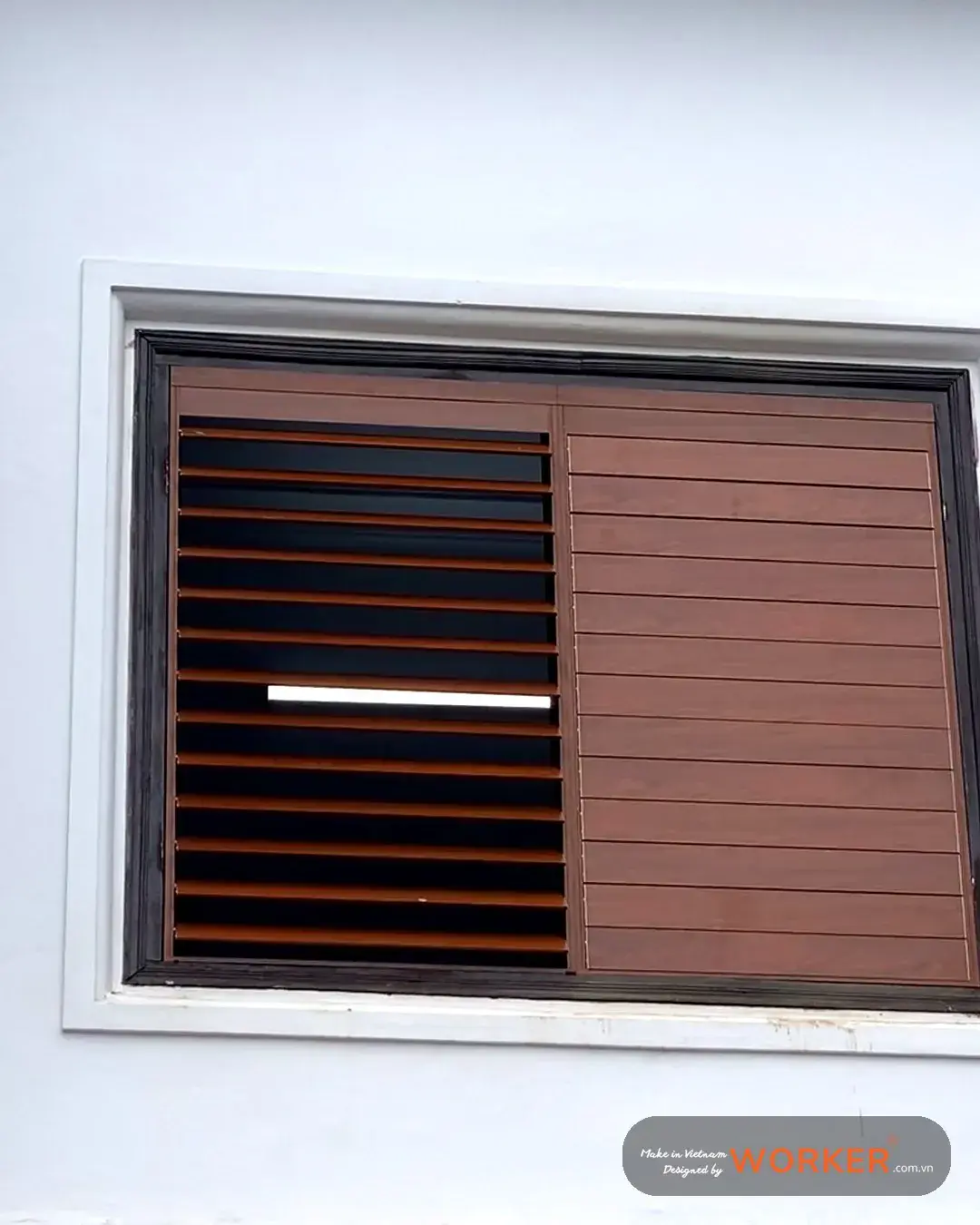
Woodgrain louvre window on a white villa, half open.
Operable louvre prices and how they are calculated
These are official prices, the same nationwide, excluding VAT (add 10% VAT for an invoice), delivery and installation. Calculation follows WORKER's software:
- Openings from 1 m²: area (m², rounded to 3 decimal places) × unit price; the amount for each set drops any remainder under 1,000 VND.
- Openings from 0.9 m² to under 1 m²: charged as 1 m².
- Openings under 0.9 m²: charged at the set price.
| Set price (openings under 0.9 m²) | Worker-Max | Worker-Pro | Worker-Smart |
|---|---|---|---|
| Under 0.2 m² | 1,600,000 VND | 1,500,000 VND | 1,200,000 VND |
| 0.2 – under 0.5 m² | 1,900,000 VND | 1,800,000 VND | 1,400,000 VND |
| 0.5 – under 0.7 m² | 2,100,000 VND | 2,000,000 VND | 1,600,000 VND |
| 0.7 – under 0.9 m² | 2,300,000 VND | 2,200,000 VND | 1,800,000 VND |
Supply and install: WORKER or a WORKER dealer installs nationwide at installed prices that include delivery and installation, excluding VAT, depending on distance and quantity: Worker-Max 2,900,000 VND/m², Worker-Pro 2,700,000 VND/m², Worker-Smart 2,200,000 VND/m². An exact quotation needs the quantities (number of sets, sizes) and the site address.
Example estimate for a townhouse
| Item | Size (mm) | System | Calculation | Amount |
|---|---|---|---|---|
| 4 room windows | 1,200 × 1,500 | Worker-Pro | 1.800 m² × 2,390,000 VND = 4,302,000 VND/set × 4 | 17,208,000 VND |
| 2 bathroom vents | 600 × 800 | Worker-Pro | 0.480 m² → set price 0.2–under 0.5 m²: 1,800,000 VND × 2 | 3,600,000 VND |
| 1 balcony screen | 3,000 × 2,700 | Worker-Max | 8.100 m² × 2,590,000 VND | 20,979,000 VND |
| 2 louvre panels on glazed doors | 800 × 600 | Worker-Smart | 0.480 m² → set price: 1,400,000 VND × 2 | 2,800,000 VND |
| Total | excluding VAT, delivery, installation | 44,587,000 VND |
Deposit: 30% of the order value, rounded up to the nearest 100,000 VND: 13,400,000 VND. Delivery takes 3–7 days depending on the time of year. For a quick price per opening, use the quote calculator.
What to send WORKER for an operable louvre quotation
The more complete the information, the faster and more accurate the quotation:
- List of openings: width × height (mm) and quantity of each type.
- Location of each opening (window, balcony, façade, lightwell…) and floor.
- Intended system for each opening, or ask WORKER to propose one by span.
- Blade direction (horizontal/vertical), divisions and blade tiers if already on the drawings.
- Which openings need motors and which need the reinforced pivot core.
- Colour (from the colour chart), elevations or photos of the existing building for refurbishment.
- Site address if WORKER or a dealer is to install.
WORKER supplies complete louvre sets including frame and blades, with fittings already assembled; blades and fittings are not sold separately. Clients who install themselves receive the complete set and fix it with screws and sealant following the measuring and installation guide, or hire a local fitter.
Maintaining operable louvres
- Clean the blade faces and gaps regularly; more often in dusty or coastal locations.
- Operate the full row of blades a few times whenever you clean, to spot any blade closing out of line early.
- Check the frame fixings and the sealant around the frame after the rainy and storm season.
- The warranty runs from handover (manufacturing defects); WORKER provides lifetime maintenance, charged according to condition after the warranty ends.
See the policy page for details.
Frequently asked questions
Are operable louvres and louvred doors the same thing?
Essentially both are openings with parallel inclined blades. Some people call the fixed-blade type a louvred door and the adjustable type an operable louvre, but the two names are often used interchangeably. In specifications and enquiries, state clearly "operable blades" or "fixed blades".
Are closed blades tight enough for air conditioning?
Yes. WORKER's three operable systems close 95–98% tight, block 95–98% of driving rain and give 80% heat insulation, so air-conditioned rooms can still use louvres. Where a room must be fully sealed in storms, combine the louvre with glazing on the inside.
What is the widest operable louvre that can be made in one piece?
Worker-Max can be made seamless up to 3.5 m thanks to its 140 mm blades with 2 internal webs. Larger screens are divided with vertical mullions. Worker-Pro is best for openings under 1.7 m.
Can operable louvres be motorised?
Yes, a louvre motor costs 2,500,000 VND per set. Which openings can take a motor is confirmed by the technical staff according to size; decide this at the design stage so that power is provided at the position.
Does WORKER sell louvre blades or fittings separately?
No. WORKER supplies complete sets including frame and blades with fittings assembled, so the blades turn smoothly and close evenly as specified.
How long is delivery, and what is the warranty?
Delivery takes 3–7 days depending on the time of year, nationwide. Product warranty is 5 years for Worker-Max and Worker-Pro (15 years on the paint) and 3 years for Worker-Smart (5–15 years on the paint), from handover.
Send your sizes for a proposal
Send your list of openings through the quote calculator or the contact page, or call 09123-357-41 (Nghệ An) or 0932-386-357 (Đà Nẵng). WORKER's technical team will propose a system for each opening and send a quotation based on the official price list. See also our completed projects.